Is private cataract surgery better than NHS?
If you’ve been told you need cataract surgery, you may be wondering whether to have it through the NHS or go privately. It’s a big decision—and one that comes down to what matters most to you.
The NHS provides excellent care. But private cataract surgery offers several important advantages, especially when it comes to flexibility, choice, and outcomes.
In this blog, we’ll explain the differences between NHS and private cataract surgery, and help you decide what’s best for your vision.
What’s the same?
Let’s start with what doesn’t change, whether you go NHS or private.
In both cases:
- Cataract surgery involves removing your cloudy natural lens
- It is replaced with a clear, artificial lens (an intraocular lens, or IOL)
- The procedure is quick, safe, and usually done under local anaesthetic
- Most people experience improved vision within days.
The core technique is similar. What differs is how the care is delivered—and what’s available to you.
The benefits of private cataract surgery
1. Shorter waiting times
NHS waiting lists can stretch for months—especially if your cataracts aren’t deemed “bad enough” yet.
With private surgery, you can usually:
- See Prof Ursell within days
- Book surgery within weeks
- Get both eyes treated sooner if needed.
For many people, this is the key reason for choosing private care.
2. You choose your surgeon
On the NHS, you may not know who will perform your surgery.
Privately, you choose a named consultant—someone like Professor Paul Ursell, who will look after you from start to finish.
That continuity builds trust and gives peace of mind.
3. Wider choice of lenses
NHS patients are usually offered a standard monofocal lens. It provides good distance vision—but you’ll likely need glasses for reading and close-up work.
With private surgery, you can access premium lens implants, including:
- Multifocal lenses – for distance and near vision
- Extended depth-of-focus lenses (EDOF) – smooth focus across ranges
- Toric lenses – correct astigmatism
These lenses can reduce or even eliminate your need for glasses.
4. Personalised care
Private consultations are longer and more tailored. Professor Ursell takes the time to:
- Understand your lifestyle and goals
- Perform advanced diagnostic scans
- Recommend the lens that suits your vision best
This isn’t just about treating a cataract—it’s about improving your quality of life.
5. Flexible scheduling
With private care, you can choose surgery dates that suit your life and commitments. You’re not bound by a waiting list or fixed schedule.
The NHS is still a good option—for the right cases
NHS cataract surgery is safe and effective. If you:
- Are happy to wait
- Don’t mind wearing glasses after surgery
- Want a basic treatment with no cost
…then NHS surgery can still be a very good solution.
But if you’re seeking a more comprehensive, faster, and personalised approach—private surgery with Prof Ursell may be the better fit.
How much does private cataract surgery cost?
Fees vary depending on:
- The surgeon
- The hospital
- The type of lens you choose.
As a general guide, private cataract surgery with a premium lens implant usually costs £3,000–£5,000 per eye.
Most clinics offer transparent pricing and payment plans to help spread the cost. You can see the costs on Prof Ursell’s website.
Final thoughts
Private cataract surgery isn’t “better” in every case. But it offers more control, more choice, and a more tailored experience.
If you want faster treatment, a premium lens, and the care of an expert like Professor Paul Ursell—private surgery may well be the right option for you.
Are you considering treatment?
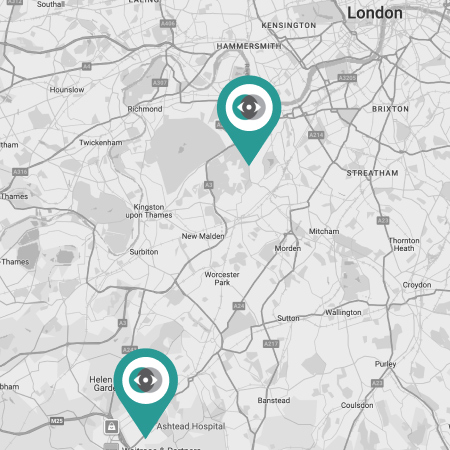
If you’re in our area and would like to learn more about your options, our team would be happy to help. Drop us a line and we’ll call you back:
[wpseo_breadcrumb]
Are you suitable for vision correction surgery?
It isn’t suitable for everyone.
To find out more about your options, book a free video appointment with your Consultant Ophthalmic Surgeon:
Our most popular procedures
What our patients say…
★ ★ ★ ★ ★“Excellent result. Complete confidence in Paul Ursell. Quiet, quick, and efficient. Peaceful and comfortable hospital.”
 P.T
P.T★ ★ ★ ★ ★
“The cataract surgery on both of my eyes went very smoothly without any problems. There was no pain afterwards and I didn’t have to wear any eyepatch. I would highly recommend Professor Ursell for cataract surgery.”
 M.S
M.S★ ★ ★ ★ ★“Highly professional, extremely efficient, and an excellent communicator, Paul exudes experience, knowledge, and ability. The whole process — initial consultation, operation, and post-op check-up — was wonderfully stress-free. I now have 20/20 vision, am glasses-free, and I am delighted by the results.”
 S.B
S.B★ ★ ★ ★ ★
“The cataract surgery has completely changed my life. Mr. Ursell put me at ease and explained all options. The procedure was quick and painless and completely successful, and I now have 20/20 vision in my good eye. One of the reasons I had the surgery was because of Mr. Ursell’s standing and experience. Cannot praise highly enough.”
 D.S
D.S★ ★ ★ ★ ★
“I was very short-sighted and my cataracts badly affected both reading and distance acuity. After the operation I now have very good distance vision (glasses-free) but still need glasses for reading. (This was the expected outcome as I did not want multi-focus implants). The operation was quick and painless, and I had no post-operative discomfort at all (which surprised me). The results are remarkable.
I can certainly recommend Professor Ursell. He is a personable consultant and a skilled surgeon.”
 S.D
S.D★ ★ ★ ★ ★
“Dr. Paul Ursell squashed many of my concerns for not having cataract surgery. He offered comfort with examples of his long/distinguished career and new technology that he applies to the surgery.
Both before and after the surgery, Dr. Ursell and staff gave me the information and attention I needed. It was a great success, and I highly recommend Dr. Ursell.”
 PTO
PTOWe have replaced the images of real patients who provided these testimonials to protect their privacy.