What is the best vision correction surgery?
When you're thinking about ditching glasses or contacts, the big question is: what is the best vision correction option?
The answer depends on your age, your eyes, and your lifestyle.
Laser vision correction
Laser procedures like LASIK, PRK, and SMILE are popular for younger people (typically under 45).
They reshape the cornea to correct nearsightedness, farsightedness, or astigmatism.
Laser vision correction works well if:
- You have a stable prescription
- You don’t have significant age-related vision changes yet
Lens replacement
If you’re over 45, laser surgery might not fix everything—especially near vision loss (presbyopia).
Lens replacement, also called refractive lens exchange (RLE), is often the better choice.
Professor Paul Ursell specialises in lens and cataract replacement.
He replaces the natural lens with an artificial one that can correct both distance and near vision—helping you avoid glasses now and cataracts later.
Premium lens options include:
- Multifocal lenses (near and distance focus)
- Extended depth of focus lenses (for more natural vision)
- Toric lenses (for astigmatism correction).
Which is best for you?
- Under 45 with a stable prescription? Laser vision correction could be ideal
- Over 45 and noticing reading glasses creeping in? Lens replacement might give you the best long-term results.
Professor Ursell will guide you through all your options during a personal consultation.
Want to find the best surgery for you?
Take our suitability self-test today and see what’s possible with Professor Paul Ursell.
Are you considering treatment?
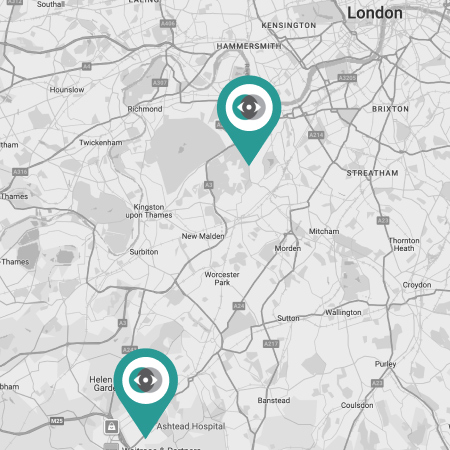
If you’re in our area and would like to learn more about your options, our team would be happy to help. Drop us a line and we’ll call you back:
Home »
Are you suitable for vision correction surgery?
It isn’t suitable for everyone.
To find out more about your options, book a free video appointment with your Consultant Ophthalmic Surgeon:
Our most popular procedures
What our patients say…
★ ★ ★ ★ ★“Excellent result. Complete confidence in Paul Ursell. Quiet, quick, and efficient. Peaceful and comfortable hospital.”
 P.T
P.T★ ★ ★ ★ ★
“The cataract surgery on both of my eyes went very smoothly without any problems. There was no pain afterwards and I didn’t have to wear any eyepatch. I would highly recommend Professor Ursell for cataract surgery.”
 M.S
M.S★ ★ ★ ★ ★“Highly professional, extremely efficient, and an excellent communicator, Paul exudes experience, knowledge, and ability. The whole process — initial consultation, operation, and post-op check-up — was wonderfully stress-free. I now have 20/20 vision, am glasses-free, and I am delighted by the results.”
 S.B
S.B★ ★ ★ ★ ★
“The cataract surgery has completely changed my life. Mr. Ursell put me at ease and explained all options. The procedure was quick and painless and completely successful, and I now have 20/20 vision in my good eye. One of the reasons I had the surgery was because of Mr. Ursell’s standing and experience. Cannot praise highly enough.”
 D.S
D.S★ ★ ★ ★ ★
“I was very short-sighted and my cataracts badly affected both reading and distance acuity. After the operation I now have very good distance vision (glasses-free) but still need glasses for reading. (This was the expected outcome as I did not want multi-focus implants). The operation was quick and painless, and I had no post-operative discomfort at all (which surprised me). The results are remarkable.
I can certainly recommend Professor Ursell. He is a personable consultant and a skilled surgeon.”
 S.D
S.D★ ★ ★ ★ ★
“Dr. Paul Ursell squashed many of my concerns for not having cataract surgery. He offered comfort with examples of his long/distinguished career and new technology that he applies to the surgery.
Both before and after the surgery, Dr. Ursell and staff gave me the information and attention I needed. It was a great success, and I highly recommend Dr. Ursell.”
 PTO
PTOWe have replaced the images of real patients who provided these testimonials to protect their privacy.