What is vision correction?
If you're struggling with blurry vision, constantly reaching for your glasses or contact lenses, you may have heard the term "vision correction." But what exactly does it mean?
Let’s break it down in simple terms—so you can understand your options, your choices, and how a specialist like Professor Paul Ursell, who focuses on lens and cataract replacement , can help you see clearly again.
What does vision correction mean?
Vision correction refers to methods used to improve eyesight, so you can see clearly at various distances—without relying on glasses or contact lenses.
It’s most often used to treat refractive errors, which are very common and include:
- Myopia (short-sightedness) – clear vision up close, but blurry in the distance
- Hyperopia (long-sightedness) – clearer vision at distance, but blurry up close
- Astigmatism – blurred or distorted vision at all distances
- Presbyopia – age-related loss of near vision, usually starting in your 40s.
The main types of vision correction
There are two main ways to correct vision:
1. Laser vision correction
Laser procedures reshape the cornea (the clear front surface of the eye) to help focus light properly. Common laser procedures include:
- LASIK
- PRK / TransPRK / SmartSurface
- SMILE
These procedures are often suitable for people under 45 who have stable prescriptions.
2. Lens-based vision correction
If you’re over 45—or if you have early cataracts—lens replacement may be more appropriate.
This procedure involves removing your natural lens and replacing it with a clear artificial lens.
Professor Paul Ursell specialises in this type of procedure . It’s often referred to as:
- Refractive Lens Exchange (RLE)
- Lens replacement
- Or simply, private cataract removal with premium lenses.
This method not only improves your vision but also prevents cataracts from developing later in life.
Types of artificial lenses used in lens surgery
The lens used in surgery is called an intraocular lens (IOL). These come in different types depending on your visual needs:
- Monofocal lenses – correct vision at one distance (usually distance); you may still need reading glasses.
- Multifocal lenses – correct both near and far vision.
- Extended Depth of Focus (EDOF) lenses – provide a smooth range of vision from distance to intermediate.
- Toric lenses – correct astigmatism.
During your consultation, Professor Ursell will guide you in choosing the lens that best matches your lifestyle and vision goals.
Benefits of vision correction surgery
- Freedom from glasses and contacts
- Sharper vision
- Long-term solution (especially with lens replacement)
- Boost in confidence and independence
- Improved night driving and reading vision.
What happens during a consultation?
A consultation is your first step. It includes:
- A full eye health check
- Precise measurements of your eyes
- A personal conversation about your vision goals
- A recommendation tailored to you.
Who is vision correction for?
Vision correction could be right for you if:
- You wear glasses or contacts every day
- You’re over 18 with a stable prescription
- You’re over 45 and tired of reading glasses
- You want a long-term solution to avoid cataracts and glasses.
Interested in finding out which option is right for you?
Take our quick self-test to see if you’re suitable for vision correction with Professor Paul Ursell.
Are you considering treatment?
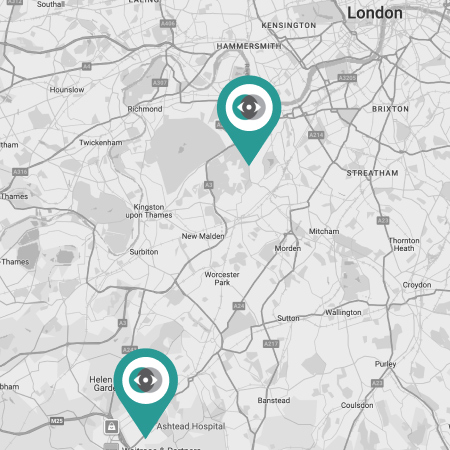
If you’re in our area and would like to learn more about your options, our team would be happy to help. Drop us a line and we’ll call you back:
Home »
Are you suitable for vision correction surgery?
It isn’t suitable for everyone.
To find out more about your options, book a free video appointment with your Consultant Ophthalmic Surgeon:
Our most popular procedures
What our patients say…
★ ★ ★ ★ ★“Excellent result. Complete confidence in Paul Ursell. Quiet, quick, and efficient. Peaceful and comfortable hospital.”
 P.T
P.T★ ★ ★ ★ ★
“The cataract surgery on both of my eyes went very smoothly without any problems. There was no pain afterwards and I didn’t have to wear any eyepatch. I would highly recommend Professor Ursell for cataract surgery.”
 M.S
M.S★ ★ ★ ★ ★“Highly professional, extremely efficient, and an excellent communicator, Paul exudes experience, knowledge, and ability. The whole process — initial consultation, operation, and post-op check-up — was wonderfully stress-free. I now have 20/20 vision, am glasses-free, and I am delighted by the results.”
 S.B
S.B★ ★ ★ ★ ★
“The cataract surgery has completely changed my life. Mr. Ursell put me at ease and explained all options. The procedure was quick and painless and completely successful, and I now have 20/20 vision in my good eye. One of the reasons I had the surgery was because of Mr. Ursell’s standing and experience. Cannot praise highly enough.”
 D.S
D.S★ ★ ★ ★ ★
“I was very short-sighted and my cataracts badly affected both reading and distance acuity. After the operation I now have very good distance vision (glasses-free) but still need glasses for reading. (This was the expected outcome as I did not want multi-focus implants). The operation was quick and painless, and I had no post-operative discomfort at all (which surprised me). The results are remarkable.
I can certainly recommend Professor Ursell. He is a personable consultant and a skilled surgeon.”
 S.D
S.D★ ★ ★ ★ ★
“Dr. Paul Ursell squashed many of my concerns for not having cataract surgery. He offered comfort with examples of his long/distinguished career and new technology that he applies to the surgery.
Both before and after the surgery, Dr. Ursell and staff gave me the information and attention I needed. It was a great success, and I highly recommend Dr. Ursell.”
 PTO
PTOWe have replaced the images of real patients who provided these testimonials to protect their privacy.