Can Diabetics Have Cataract Surgery?
If you have diabetes and you've just been told you have a cataract, you might be wondering whether one affects the other, and whether surgery is still an option. It's a good question to ask before you book anything.
The short answer is yes. Having diabetes doesn't rule you out. At Cataract Doctor, Professor Paul Ursell decides whether surgery suits you after a full assessment of your eyes and a conversation about your health. The NHS says cataract surgery improves vision for most people, and serious complications are rare. Our guide to cataract surgery complications explains the risks in more detail.
Your diabetes and the health of your eyes simply become part of the planning, so your surgery and aftercare fit you. This post covers how diabetes and cataracts are linked, what Professor Ursell checks at your assessment, and how to prepare. It's general information, and we'll advise on your own eyes at your consultation.
How diabetes and cataracts are linked
The NHS lists type 2 diabetes among the long-term health conditions that can raise your risk of cataracts.
That doesn't mean everyone with diabetes will get one. It's worth knowing, though, and worth having any change in your sight checked properly rather than guessing at the cause. Our guide on how to prevent cataracts also recommends keeping any long-term condition well managed.
Why we look at more than the cataract
Diabetes can also affect the retina, the light-sensitive layer at the back of the eye. This is called diabetic retinopathy, and the NHS offers diabetic eye screening to check for it.
It matters for cataract surgery because Professor Ursell needs to understand the back of your eye, not only the cloudy lens at the front. An article from the European Society of Cataract and Refractive Surgeons (ESCRS) notes that people with diabetes have a higher risk of swelling at the centre of the retina after cataract surgery, known as diabetic macular oedema. That risk rises with the severity of diabetic retinopathy.
This is one reason every assessment at Cataract Doctor includes an OCT scan. Our consultation guide describes it as "a special scan of your retina to check for any underlying issues". Our guide to advanced diagnostic technology explains how OCT produces high-resolution images of the retina and optic nerve, helping to spot conditions like macular degeneration or diabetic changes.
What to expect at your consultation
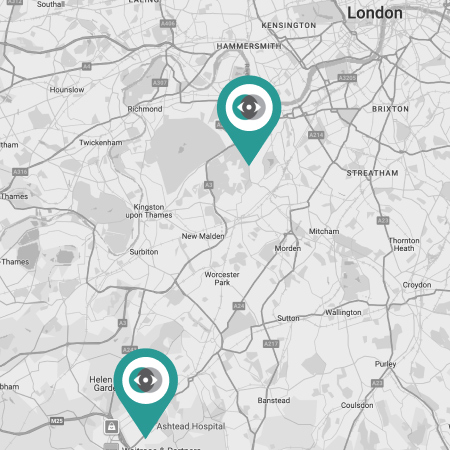
Your consultation lasts around 30 minutes, at either Parkside Hospital in Wimbledon or Ashtead Hospital in Surrey. It's unhurried, with a full eye health assessment, including measurements, scans and drops to dilate your pupils. Your vision will be blurry for around 30 minutes to an hour and a half afterwards, so you won't be able to drive. Bring someone with you or plan another way home.
If you have diabetes, it helps to come ready to talk about:
- Your diabetes, and any diabetes medication you take
- Any other health conditions, allergies and regular prescriptions
- Any eye problems you already know about, including anything found at diabetic eye screening
If you wear soft contact lenses, stop wearing them at least a week before your consultation. If you wear hard (rigid gas permeable) lenses, call Professor Ursell's team, who will talk you through what to do.
Your overall health is part of how suitability is decided, as we explain in our post on whether cataract surgery is right for you. Once your tests are done, Professor Ursell talks you through the results, and you'll get a detailed assessment and a treatment plan built around your vision and lifestyle.
When the retina needs attention first
Sometimes a retinal problem needs treating before cataract surgery, or around the same time. If that applies to you, we'll explain it at your consultation. The ESCRS article describes getting the retina into the best possible condition before a person with diabetes is referred for cataract surgery.
It can work the other way, too. An advanced cataract can make the back of the eye hard to see, which makes retinal checks and treatment more difficult. In that case, removing the cataract can be part of looking after the retina.
Getting ready for the day
Our guide on how to prepare for private cataract surgery explains that you can take your prescribed medications as normal, including diabetes medications. You can usually have a light meal and water beforehand, unless you're told otherwise.
Diabetes treatment differs from person to person, so ask us exactly what applies to you before the day and follow the instructions you're given. Arrange a lift home, and avoid eye makeup, creams and perfume on the day.
The surgery itself uses Professor Ursell's no needle, no patch technique. Your eye is numbed with drops rather than an injection, the procedure takes less than 10 minutes, and you go home without a patch.
Aftercare and your eye drops
After surgery, you'll use eye drops as directed by Professor Ursell. NICE guidance on cataracts says surgeons should consider combining a steroid drop with an anti-inflammatory (NSAID) drop for people at higher risk of swelling at the centre of the retina, and gives diabetes as an example. Professor Ursell goes a step further and uses both types of drop routinely for every patient after cataract surgery. Our post on how long to use eye drops after cataract surgery covers the routine.
Recovery is quick. There's no shield to wear at night, and most patients are back to their normal activities, such as yoga, showering and the gym, the next day.
At your follow-up appointment, we check how your eye is healing, and your price includes four weeks of follow-up appointments. Cataract surgery treats the cataract, while diabetic eye screening looks for diabetic retinopathy, which is a separate condition. So please keep going to your diabetic eye screening appointments as well.
Diabetes and cataract surgery at a glance
Final thoughts
Diabetes doesn't close the door on cataract surgery, but it does make a thorough assessment more important, and that's what you'll get with us. Take our quick cataract suitability self-test to see where you stand, or book a consultation to talk through your eyes and your diabetes with Professor Ursell. If you'd rather start with a conversation, our cataract surgery page also offers a free video call assessment.
Frequently asked questions
Are you considering treatment?
If you’re in our area and would like to learn more about your options, our team would be happy to help. Drop us a line and we’ll call you back:
[wpseo_breadcrumb]
Are you suitable for vision correction surgery?
It isn’t suitable for everyone.
To find out more about your options, book a free video appointment with your Consultant Ophthalmic Surgeon:
Our most popular procedures
What our patients say…
★ ★ ★ ★ ★“Excellent result. Complete confidence in Paul Ursell. Quiet, quick, and efficient. Peaceful and comfortable hospital.”
 P.T
★ ★ ★ ★ ★
“The cataract surgery on both of my eyes went very smoothly without any problems. There was no pain afterwards and I didn’t have to wear any eyepatch. I would highly recommend Professor Ursell for cataract surgery.”
 M.S
★ ★ ★ ★ ★“Highly professional, extremely efficient, and an excellent communicator, Paul exudes experience, knowledge, and ability. The whole process — initial consultation, operation, and post-op check-up — was wonderfully stress-free. I now have 20/20 vision, am glasses-free, and I am delighted by the results.”
 S.B
★ ★ ★ ★ ★
“The cataract surgery has completely changed my life. Mr. Ursell put me at ease and explained all options. The procedure was quick and painless and completely successful, and I now have 20/20 vision in my good eye. One of the reasons I had the surgery was because of Mr. Ursell’s standing and experience. Cannot praise highly enough.”
 D.S
★ ★ ★ ★ ★
“I was very short-sighted and my cataracts badly affected both reading and distance acuity. After the operation I now have very good distance vision (glasses-free) but still need glasses for reading. (This was the expected outcome as I did not want multi-focus implants). The operation was quick and painless, and I had no post-operative discomfort at all (which surprised me). The results are remarkable.
I can certainly recommend Professor Ursell. He is a personable consultant and a skilled surgeon.”
 S.D
★ ★ ★ ★ ★
“Dr. Paul Ursell squashed many of my concerns for not having cataract surgery. He offered comfort with examples of his long/distinguished career and new technology that he applies to the surgery.
Both before and after the surgery, Dr. Ursell and staff gave me the information and attention I needed. It was a great success, and I highly recommend Dr. Ursell.”
 PTO
We have replaced the images of real patients who provided these testimonials to protect their privacy.